Gross plot area
The total land inside the legal site boundary.
AAC INVESTOR ACADEMY · SITE PLANNING
AAC plant land requirement is not determined by capacity alone. Process flow, stockyards, utilities, plot geometry and future expansion must be evaluated before the site is finalised.
Generic acreage figures are suitable only for early screening.
01 · Understand
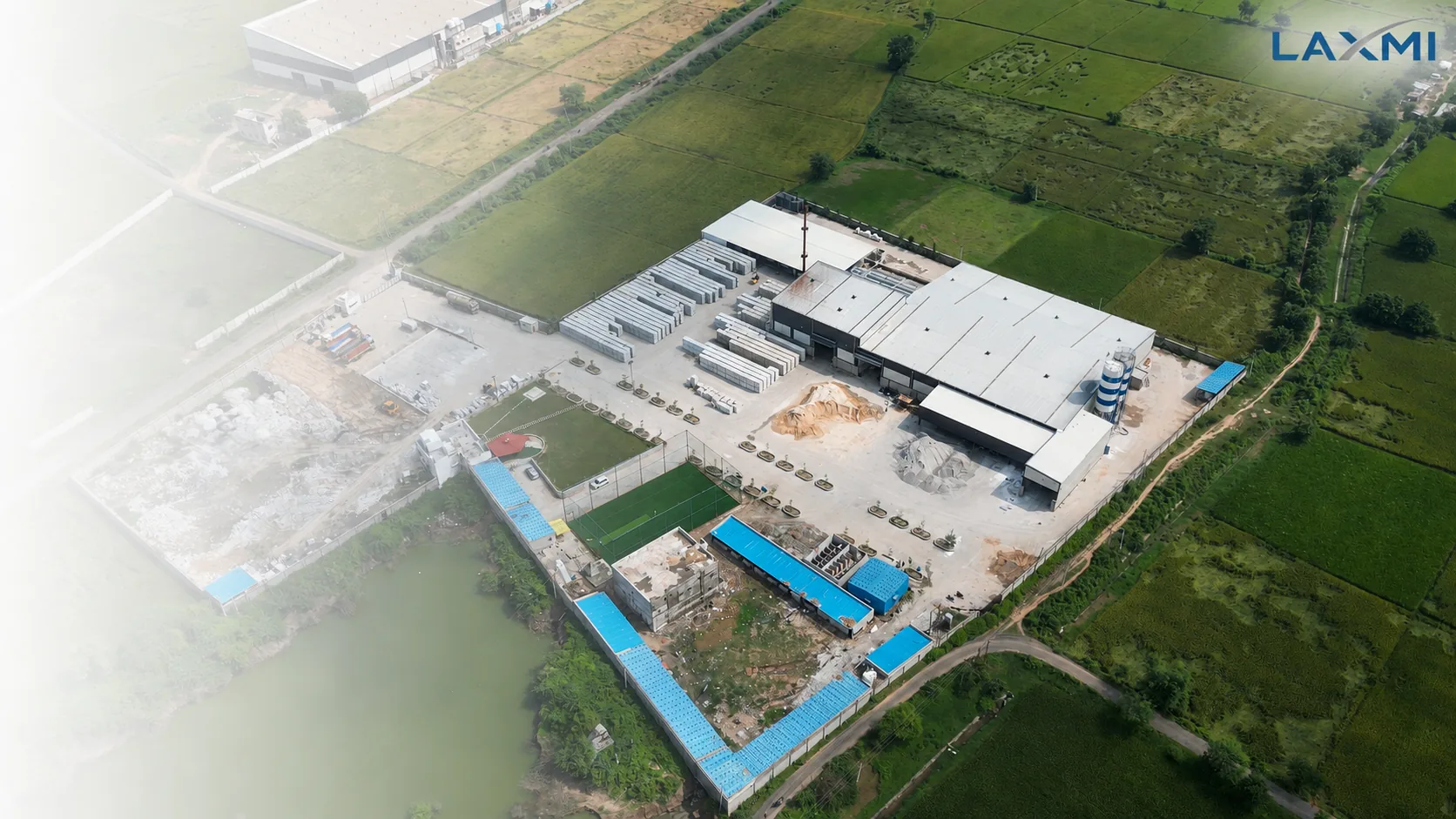
The production shed occupies only one part of an AAC manufacturing site.
The complete plot must also support raw materials, mould circulation, cutting, autoclaving, utilities, finished goods, roads, dispatch and future development.
Direct answer
There is no universal acreage for an AAC plant. The right land area emerges from a project-specific master layout based on operating and commercial assumptions.
The total land inside the legal site boundary.
Land remaining after access, setbacks, drainage and unusable geometry.
Space intentionally protected for a technically balanced later phase.
The central principle
02 · Evaluate
Each factor changes land use, operating movement or capital exposure. They must be reviewed together rather than converted into one universal acreage promise.
Rated output, operating hours, production days and maintenance allowances shape circulation and storage needs.
Fly ash, pond ash and sand-based plants need different receiving, preparation and inventory arrangements.
Stockyard area follows inventory days, product mix and dispatch rhythm—not daily production alone.
Panel production can add reinforcement, handling, inspection, storage and loading requirements.
Usable length, width, access and expansion direction can matter more than acreage on paper.
The layout should limit backtracking, repeated transfer and crossing between production and dispatch traffic.
Boiler, fuel, water, power, maintenance, laboratory and safety access need planned space.
Phase-2 autoclaves, utilities, panels and stockyards must be protected in the original master plan.
Stockyard reality
A plant producing regularly but dispatching unevenly may need more finished-goods space than another plant of the same capacity with faster inventory movement.
Common mistakes
A plot can restrict the practical plant configuration before machinery is even selected.
Storage, roads, unloading, dispatch, utilities and statutory provisions remain outside the shed.
Uneven dispatch can create congestion even when production itself is well planned.
Later additions can create access, relocation and operating-interference constraints.
03 · Decide
Expansion-ready does not mean purchasing every future machine today.
It means protecting the positions, routes and utility provisions that become difficult to change after production begins.
| Strategy | Potential advantage | Principal risk | Planning response |
|---|---|---|---|
| Minimum workable plot | Lower initial land commitment | Congestion, storage or expansion constraint | Use only after a detailed movement study |
| Balanced operating plot Preferred principle | Supports practical flow and inventory | Requires reliable project inputs | Align layout with realistic operating assumptions |
| Expansion-ready master plan | Protects phased growth | Poor Phase-1 positioning can still block Phase 2 | Reserve corridors, utilities and future equipment positions |
| Undefined excess land | Additional space appears available | Capital may remain underutilised | Purchase against a visible phased development plan |
Laxmi En-Fab methodology
Production sequence, equipment position, mould movement, cutting, autoclaves and packing.
Raw-material unloading, internal traffic, stockyard movement, truck circulation and dispatch.
Boiler, fuel, electrical, water, maintenance, laboratory and service access.
Additional capacity, autoclaves, panel production, utilities and warehouse growth.
Before a preliminary review
Investor questions
There is no universal acreage. Capacity, plot dimensions, raw-material storage, finished-goods inventory, process configuration, utilities, product mix and future expansion must be assessed together.
No. Capacity is one input, but it does not define stockyard requirements, plot geometry, truck circulation, utility areas or statutory setbacks.
Not necessarily. Automation changes handling and equipment integration, while total land still depends on process configuration, storage, roads, utilities and expansion planning.
It may require additional provision for reinforcement-related activity, specialised handling, inspection, storage and loading. The exact scope depends on the proposed panel products and process.
Expansion land should follow a phased master plan. Undefined excess land can block capital, while the wrong expansion corridor can still restrict future development.
Share the target capacity, plot drawing and dimensions, location, raw-material route, product mix, inventory assumptions, utility scope, access and future-expansion objective.
Before the land is finalised
Share the site dimensions, target capacity, raw-material route, product mix and expansion objective for a focused engineering discussion around the inputs that should shape the master plan.