Peak flow
How many cakes or block groups reach the line within the shortest handling window.
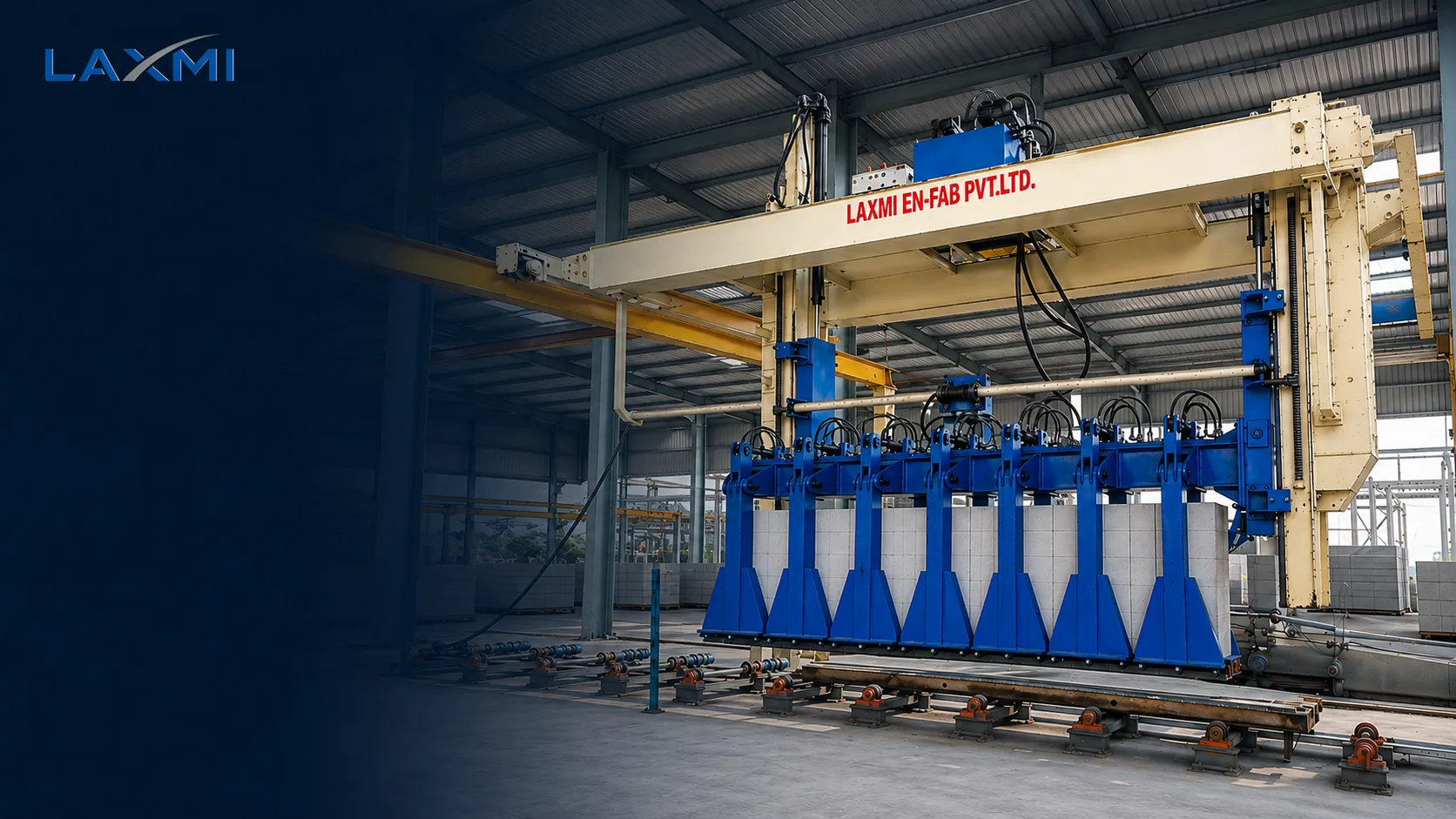
Post-autoclave automation
A project-specific handling line that coordinates separation, inspection, grouping, stacking and pack preparation around the plant’s actual finished-product flow.
Designed from peak flow, product mix and dispatch logic—not capacity alone.
Direct answer
An AAC auto palletizing system is used after autoclaving to move finished AAC blocks through the required separation, inspection, grouping, stacking and pack-preparation stages.
Its purpose is not simply to replace workers with machines. It must accept the plant’s peak output, create stable dispatch-ready packs and prevent finished-product handling from constraining production.
The central engineering question
Increasing batching, cutting or autoclaving capacity does not automatically increase dispatch-ready output. If downstream handling cannot clear peak discharge, material accumulates and the post-autoclave section becomes the constraint.
Four design drivers
How many cakes or block groups reach the line within the shortest handling window.
Cake dimensions, block sizes, stack patterns and the frequency of recipe changes.
Pallet, alternative support, packaging and the movement route to the stockyard.
Maintenance skills, recovery philosophy and the level of automation the team can support.
Operating sequence
The sequence shown is representative. The final equipment and interfaces depend on production technology, cake orientation and agreed project scope.
Move the cured cake or block group from autoclave unloading into the finished-product handling area.
Align the product for separation, inspection or grouping with controlled, repeatable movement.
Separate cured blocks or layers where required by the selected AAC production process.
Identify and remove damaged or non-conforming blocks without disrupting the complete sequence.
Group blocks into the required dispatch pattern using the agreed product and pack recipes.
Place the stack on the selected support and release it to the stockyard handling method.
Choose intelligently
Not every AAC plant requires a completely automatic line. The correct decision is the lowest practical automation level that meets output, pack quality, safety and operating objectives without unnecessary complexity.
| Configuration | Where it may fit | Main value | Important limitation |
|---|---|---|---|
| Manual handling | Lower output, simple product mix or manageable labour and cycle conditions. | Lower initial investment, simple recovery and flexibility. | Greater labour dependence and difficult to scale consistently. |
| Selective automation | Where specific repetitive or labour-intensive stages are the clear bottleneck. | Targets high-value operations while retaining flexibility. | Manual and automatic interfaces must be balanced carefully. |
| Integrated automation | Demanding peak flow, repeated pack patterns and a justified business case. | Coordinated movement and recipe-based operation. | Higher integration and maintenance requirements; recovery must be designed. |
System sizing
A responsible proposal states the agreed design basis, operating conditions, exclusions and acceptance criteria. Universal cycle time, utility, manpower or output values should not be assumed.
Present requirement and future expansion provision.
Cakes or block groups arriving within the shortest operating window.
Transfer, gripping, separation and layout requirements.
Grouping recipes, changeovers and stack patterns.
Layers, stack dimensions, support and stability.
Floor area, clear height, access, buffers and maintenance zones.
Finished-pack release, vehicle movement and dispatch logic.
Integration, recovery philosophy and maintainable automation level.
Balanced engineering
Potential operational value
Conditions and limitations
New plant or retrofit
In a new plant, unloading, buffers, maintenance access, controls and stockyard flow can be coordinated from the beginning.
For an operating plant, foundations, rails, floor levels, columns, utilities, controls, movement routes and the allowable installation shutdown must first be surveyed.
Evaluate an existing-plant upgradeBuyer questions
Clear answers before a proposal help define scope, responsibilities and realistic expectations.
It is a post-autoclave material-handling line that coordinates the required transfer, separation, inspection, grouping, stacking and pack-preparation stages. The exact included operations depend on the agreed project scope.
No. The decision depends on peak finished-product flow, product mix, labour arrangement, pack format, available space, maintenance capability and project economics. Manual or selective automation may be more appropriate for some plants.
No. Nominal daily capacity does not show how quickly products arrive after autoclaving. Peak discharge, cakes per handling window, cake dimensions and the required pack cycle must also be evaluated.
Not necessarily. Separation may be a separate machine, an upstream operation or part of an integrated line. The proposal should state the scope boundary clearly.
A project may be designed with multiple recipes, but supported dimensions, stack patterns, changeover methods and mechanical adjustments must be confirmed during engineering.
A retrofit may be possible after surveying the existing unloading method, space, foundations, floor levels, utilities, controls, stockyard movement and allowable shutdown period.
No. Operators may still be required for inspection, rejected-block removal, packaging-material replenishment, forklift movement, cleaning, supervision and maintenance.
No universal reduction should be assumed. Damage depends on incoming block condition, separation quality, alignment, gripping, movement, support and operating practice.
Plan before specifying
Share your plant capacity, peak autoclave discharge, cake size, product mix, existing layout and preferred pack method. The discussion will focus on the appropriate handling sequence, automation boundary and proposal inputs.