Face trimming
A cutting wire removes the main excess material from the green cake ends. A finishing blade then refines the face and establishes the specified finished length.
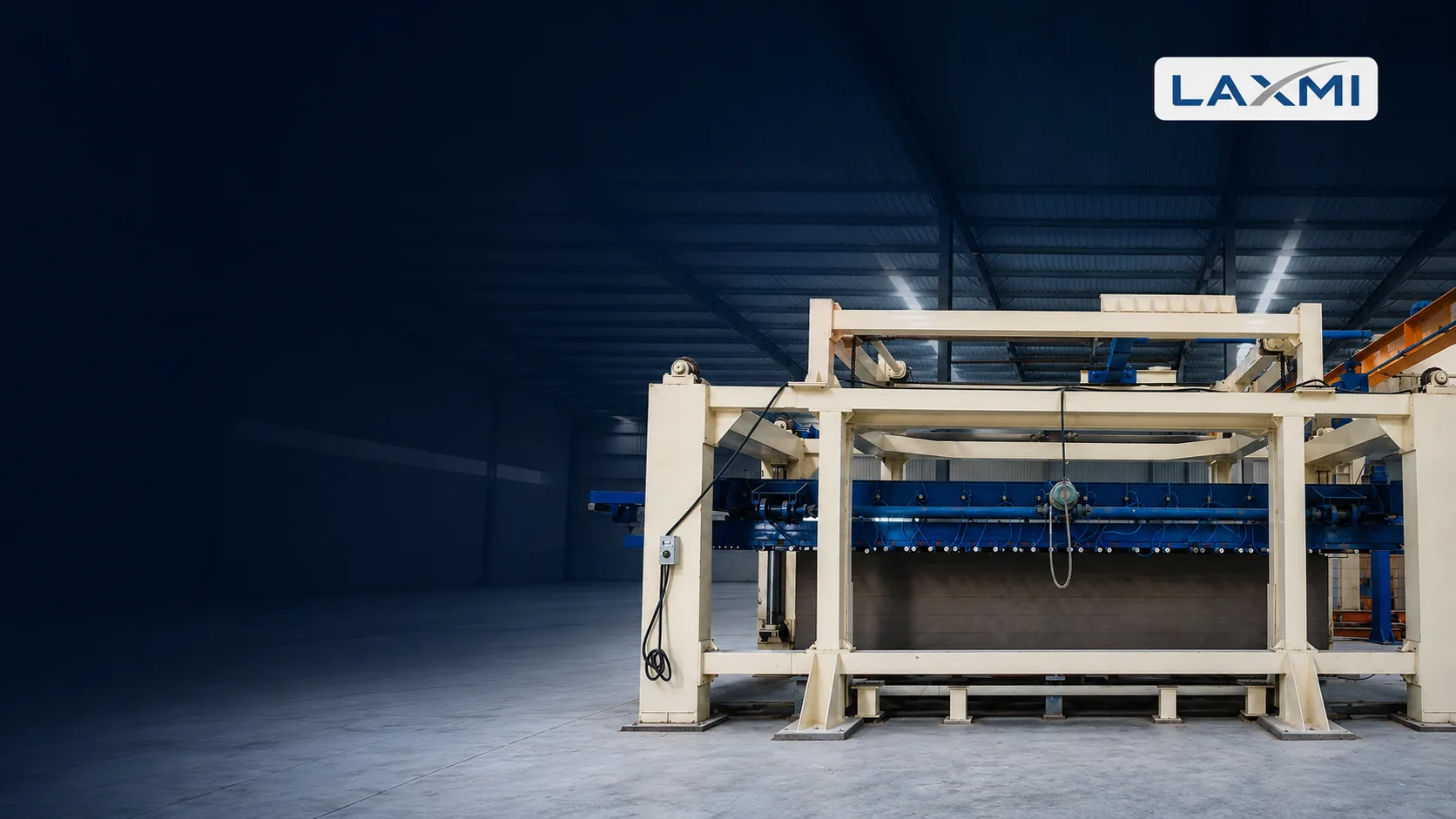
AAC PLANT MACHINERY
Controlled green-cake handling, face trimming, horizontal and vertical cutting, and waste recovery—configured around the complete AAC production process.
For new AAC plants, expansion projects and cutting-section upgrades.
DIRECT ANSWER
An AAC cutting system cuts a pre-cured green cake into the required block dimensions before autoclaving.
Cutting quality depends on more than the machine alone. Cake condition, alignment, wire positioning, blade setting and controlled movement must work together.
THE CUTTING JOURNEY
A cutting wire removes the main excess material from the green cake ends. A finishing blade then refines the face and establishes the specified finished length.
Arranged cutting wires establish one required product dimension. The controlled dimension depends on cake orientation and the approved cutting-system layout.
The cake is divided along the other required axis. Cutting movement, side-plate position and cake transfer must remain coordinated.
Trimming and cutting waste is collected for controlled return to the waste-slurry preparation process, subject to plant trials and quality control.
FACE FINISHING
Blade angle, condition and alignment can influence the finished cake face. An unsuitable setting can contribute to corner damage, surface marks, uneven finishing or excessive cutting resistance.
Blade adjustment cannot correct every defect. Cake hardness, pre-curing, movement, machine alignment and raw-material consistency must also be checked.
ACCURACY DRIVERS
A cake that is too soft may deform; an excessively hard cake may increase cutting resistance.
Spacing, condition and tension influence dimensional consistency and the quality of the cut surface.
The side plate, transfer cart, guide system and cutting frames must remain correctly aligned.
Starting, stopping and transfer should avoid unnecessary jerk while the pre-cured cake is being handled.
DIAGNOSTIC THINKING
These checks are starting points. The complete process should be reviewed before concluding that a defect originates in the cutting machine.
| Observed problem | Cutting-related checks | Additional process checks |
|---|---|---|
| Corner damage | Blade angle, blade condition, wire exit and sudden movement | Cake strength, pre-curing and mould release |
| Dimensional variation | Wire spacing, tension, frame alignment and plate position | Cake deformation and recipe consistency |
| Uneven face finish | Blade alignment, wear and cutting movement | Cake hardness and material consistency |
| Frequent wire breakage | Wire specification, tension, alignment and obstruction | Cake hardness and contamination |
| Trench blockage | Cleaning frequency, circulation and pipeline condition | Waste volume and slurry settlement |
CUTTING WASTE RECOVERY
Green material from trimming and cutting can be collected and returned through a controlled waste-slurry system.
The usable proportion must not be treated as a fixed percentage. It depends on raw materials, recipe, recovered-slurry density, water balance, contamination control and quality results.
Establish the permissible recovered-slurry proportion through plant trials and quality control.
Waste falls into a trench and is circulated toward waste-slurry preparation. Cleaning, pump condition, settlement and pipeline blockage require regular attention.
Where layout and process design permit, green waste can be transferred separately toward the slurry-handling area to reduce direct slurry accumulation in the cutting trench.
AUTOMATION DEFINED
01Cake-position detection and transfer movement
02Cutting-frame sequence and recipe selection
03Fault alarms, interlocks and emergency-stop logic
04Manual, automatic and maintenance modes
Automatic operation does not eliminate trained supervision. Operators still need to understand cake condition, size settings, wire inspection, alarm response and safe maintenance.
SYSTEM SELECTION
Price comparison is meaningful only when cake handling, controls, waste recovery, installation and interface responsibilities are compared on an equivalent scope.
Sets the required cycle and line coordination
Defines the machine geometry
Determines wire spacing and flexibility
Defines manual steps, controls and interlocks
Influences trench, pump and slurry-system design
Critical for expansion and retrofit projects
NEW AAC PLANT
Coordinate mould dimensions, tilting, pre-curing, cake transfer, grouping, autoclave loading, automation and waste recovery.
EXISTING PLANT
Review side plates, foundations, rail arrangement, controls, cycle, waste system, available space and permitted shutdown.
FREQUENTLY ASKED
An AAC cutting system cuts a pre-cured green AAC cake into the required product dimensions before autoclaving. Depending on the plant configuration, it can include cake transfer, face trimming, horizontal and vertical wire cutting, bottom-layer removal and cutting-waste recovery.
In the process described here, the green cake is cut after pre-curing and demoulding but before autoclaving. Separate post-autoclave sawing equipment may be used for special finished-product applications.
Important factors include cake condition, wire spacing and tension, blade setting, machine alignment, side-plate condition, cake movement and consistent upstream process control.
A system can be configured for multiple sizes, but the supported range, wire arrangement and changeover method must be confirmed in the project specification.
Green cutting waste can be collected, converted into controlled waste slurry and returned to production. The usable proportion depends on the recipe, raw materials, slurry properties and quality-control results.
Yes, subject to a technical assessment of cake size, side plates, layout, foundations, transfer arrangement, controls, waste recovery and the available shutdown period.
PROJECT-SPECIFIC ENGINEERING
Share your planned capacity, cake size, required products, plant layout, automation level and current cutting problem. Receive a focused technical discussion around the complete process.